Tuesday, April 3, 2012

Interview of Jonah Stein

I was recently chatting with Jonah Stein about Panda & we decided it probably made sense to do a full on interview.

You mentioned that you had a couple customers that were hit by Panda. What sort of impact did that have on those websites?

Both of these sites saw an immediate hit of about 35% of google traffic. Ranking dropped 3-7 spots. The traffic hit was across the board, especially in the case of GreatSchools, who saw all content types hit (school profile pages, editorial content, UGC)

GreatSchools was hit on the 4-9 (panda 2.0) update and called out in the Sistrix analysis.

How hard has GreatSchools been hit? Sistrix data suggested that GreatSchools was loosing about 56% of Google traffic. The real answer is that organic Google-referred traffic to the site fell 30% on April 11 (week over week) and overall site entries are down 16%. Total page views are down 13%. The penalty, of course, is a ?site wide? penalty but not all entry page types are being affected equally

Google suggested that there was perhaps some false positives but that they were generally pretty satisfied with the algorithms. For sites that were hit, how do clients respond to the SEOs? I mean did the SEO get a lot of the blame or did the clients get that the change was sort of a massive black swan?

I think I actually took it harder then they did. Sure, it hit their bottom line pretty hard, but it hit my ego. Getting paid is important but the real rush for me is ranking #1.

Fortunately none of my clients think they are inherently entitled to Google traffic, so I didn't get blamed. They were happy that I was on top of it (telling them before they noticed) and primarily wanted to know what Panda was about.

Once you get over the initial shock and the grieving, responding to Panda was a rorschach test, everyone saw something different. But is also an interesting self - reflection, especially when the initial advice coming from Greg Boser and a few others was to start to de-index content.

For clients who are not ad driven, the other interesting aspect is that generally speaking conversions were not hurt as much as traffic, so once you start focusing on the bottom line you discover the pain is a little less severe than it seemed initially.

So you mentioned that not all pages were impacted equally. I think pages where there was more competition were generally hit harder than pages that had less competition. Is that sort of inline with what you saw?

Originally I thought that was maybe the case, but as I looked at the data during the recovery process I became convinced that Panda is really the public face of a much deeper switch towards user engagement. While the Panda score is sitewide the engagement "penalty" or weighting effect on also occurs at the individual page. The pages or content areas that were hurt less by Panda seem to be the ones that were not also being hurt by the engagement issue.

On one of my clients we moved a couple sections to sub-domains, following the HubPages example and the experience of some members of your community. The interesting thing is that we moved the blog from /blog to blog.domain.com and we moved one vertical niche from /vertical-kw to vertical-kw.example.com. The vertical almost immediately recovered to pre-panda levels while the traffic to the blog stayed flat.

So the vertical was suddenly getting 2x the traffic. On the next panda push the vertical dropped 20% but that was still a huge improvement over before we moved to the subdomain. The blog didn't budge.

The primary domain also seemed to improve some, but it was hard to isolate that from the impact of all of the other changes, improvements and content consolidation we were doing.

After the next panda data push did not kill the vertical sub domain, we elected to move a second one. On the next data push, everything recovered - a clean bill of health - no pandalization at all.

but....

GreatSchools completely recovered the same day and that was November 11th, so Panda 3.0. I cannot isolate the impact of any particular change versus Google tweaking the algorithm and I think both sites were potentially edge cases for Panda anyway.

Now that we are in 3.3 or whatever the numbering calls it, I can say with confidence that moving "bad" content to a sub-domain carries the Panda score with it and you won't get any significant recovery.

You mentioned Greg Boser suggesting deindexing & doing some consolidation. Outside of canonicalization, did you test doing massive deindexing (or were subdomains your main means of testing isolation)?

We definitely collapse a lot of content, mostly 301s but maybe 25% of it was just de-indexing. That was the first response. We took 1150 categories/keyword focused landing pages and reduced to maybe 300. We did see some gains but nothing that resembled the huge boost when Panda was lifted.

Back to the rorschach test: We did a lot of improvements that yielded incremental gains but were still weighed down. I reminds me of when I used to work on cars. I had this old Audi 100 that was running poorly so I did a complete tune up, new wires, plugs, etc., but it was still running badly. Then I noticed the jet in the carburetor was mis-aligned. As soon as I fixed that, boom, the car was running great. Everything else we fixed may have been the right thing to do for SEO and/or users but it didn't solve the problem we were experiencing.

The other interesting thing is that I had a 3rd client who appeared to get hit by Panda or at least suffer from Panda like symptoms after their host went down for about 9 hours. Rankings tanked across the board, traffic down 50% for 10 days. They fully recovered on the next panda push. My theory is that this outage pushed their engagement metrics over the edge somehow. Of course, it may not have really been Panda at all but the ranking reports and traffic drops felt like Panda. The timing was after November 11th, so it was a more recent version of the Panda infrastructure.

Panda 1.0 was clearly a rush job and 2.0 seemed to be a response to the issues it created and the fact that demand media got a free pass. I think it took 6-8 months for them to really get the infrastructure robust.

My takeaways from Panda are that this is not an individual change or something with a magic bullet solution. Panda is clearly based on data about the user interacting with the SERP (Bounce, Pogo Sticking), time on site, page views, etc., but it is not something you can easily reduce to 1 number or a short set of recommendations. To address a site that has been Pandalized requires you to isolate the "best content" based on your user engagement and try to improve that.

I don't know if it was intentional or not but engagement as a relevancy factor winds up punishing sites who have built links and traffic through link bait and infographics because by definition these users have a very high bounce rate and a relatively low time on site. Look at the behavioral metrics in GA; if your content has 50% of people spending less than 10 seconds, that may be a problem or that may be normal. The key is to look below that top graph and see if you have a bell curve or if the next largest segment is the 11-30 second crowd.

I also think Panda is rewarding sites that have a diversified traffic stream. The higher percentage of your users who are coming direct or searching for you by name (brand) or visiting you from social the more likely Google is to see your content as high quality. Think of this from the engine's point of view instead of the site owner. Algorithmic relevancy was enough until we all learned to game that, then came links as a vote of trust. While everyone was looking at social and talking about likes as the new links they jumped ahead to the big data solution and baked an algorithm that tries to measure interaction of users as a whole with your site. The more time people spend on your site, the more ways they find it aside from organic search, the more they search for you by name, the more Google is confident you are a good site.

Based on that, are there some sites that you think have absolutely no chance of recovery? In some cases did getting hit by Panda cause sites to show even worse user metrics? (there was a guy named walkman on WebmasterWorld who suggested that some sites that had "size 13 shoe out of stock" might no longer rank for the head keywords but would rank for the "size 13" related queries.

I certainly think that if you have a IYP and you have been hit with Panda your toast unless you find a way to get huge amounts of fresh content (yelp). I don't think the size 13 shoe site has a chance but it is not about Panda. Google is about to roll out lots of semantic search changes and the only way ecommerce sites (outside of the 10 or so brands that dominate Google Products) will have a chance is with schema.org markup and Google's next generation search. The truth is the results for a search for shoes by size is a miserable experience at the moment. I wear size 16 EEEE, so I have a certain amount of expertise on this topic. :)

Do you see Schema as a real chance for small players? Or something that is a short term carrot before they get beat with the stick? I look at hotel search results like & and I fear that spreading as more people format their content in a format that is easy to scrape & displace. (For illustration purposes, in the below image, the areas in red are clicks that Google is paid for or clicks to fraternal Google pages.)
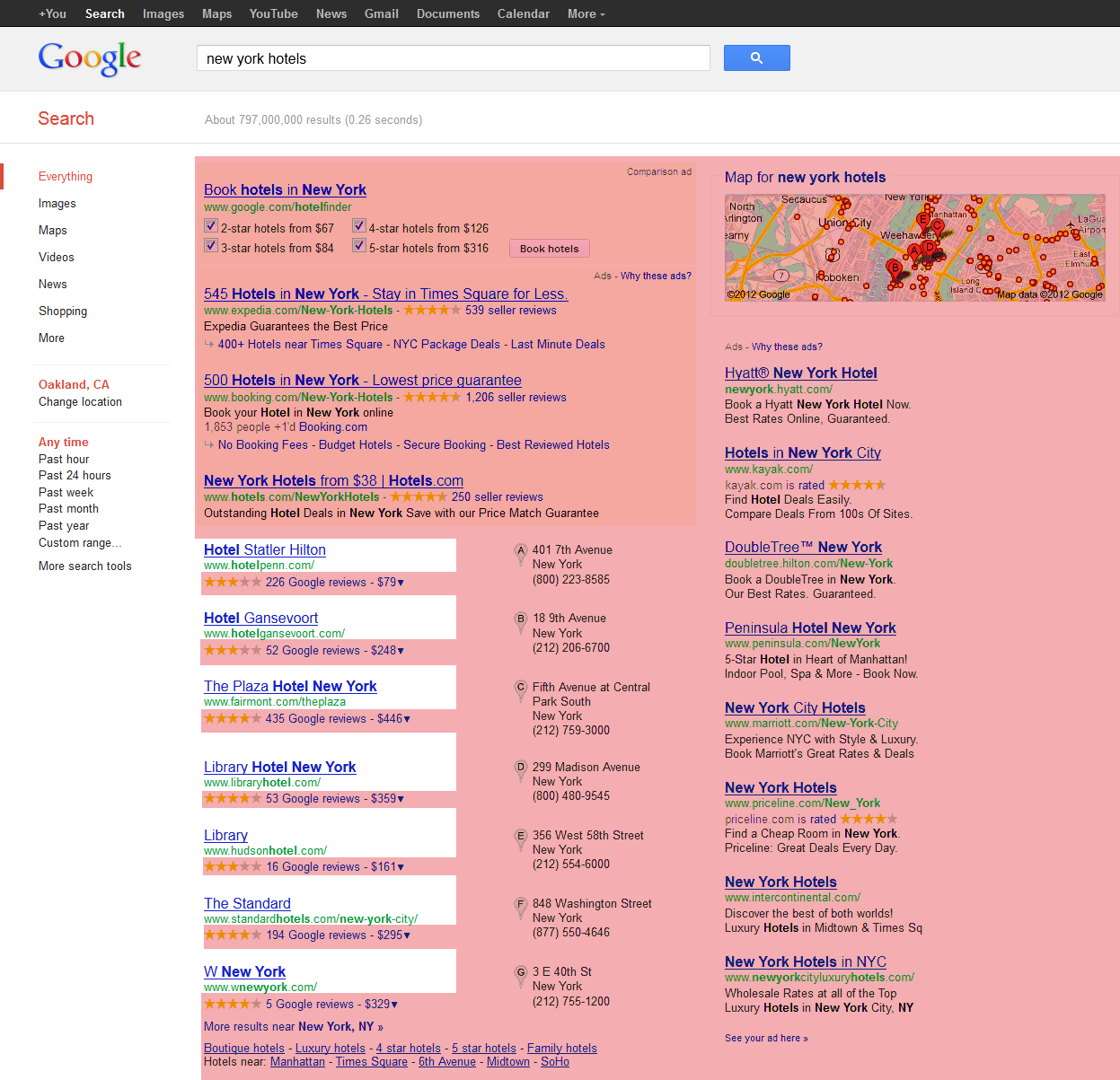
I doubt small players will be able to use Schema as a lifeline but it may keep you in the game long enough to transition into being a brand. The reason I have taken your advice about brands to heart and preach it to my clients is that it is short sighted to believe that any of the SEO niche strategies are going to survive if they are not supported with PR, social, PPC and display.

More importantly, however, is that they are going to focus on meeting the needs of the user as opposed to simply converting them during that visit. To use a baseball analogy, we have spent 15 years keeping score of home runs while the companies that are winning the game have been tracking walks, singles, doubles and outs. Schema may deliver some short term opportunities for traffic but I don't think size13shoes.com will be saved by the magic of semantic markup.

On the other hand, if I were running an ecommerce store, particularly if I was competing with Amazon, Bestbuy, Walmart and the hand full of giant brands that dominate the product listings in the SERP, I wouldn't bury my head in the sand and pretend that everyone else wasn't moving in that direction anyway. Maybe if you can do it right you can emerge as a winner, at least over the short and medium term.

In that sense SEO is a moving target, where "best practices" depend on the timing in the marketplace, the site you are applying the strategy to, and the cost of implementation.

Absolutely...but that is only half the story. If you are an entrepreneur who likes to build site based on a monetization strategy, then it is a moving target where you always have to keep your eyes on the horizon. For most of my clients the name of the game is actually to focus on trying to own your keyword space and take advantage of inertia. That is to say that if you understand the keywords you want to target, develop a strategy for them and then go out and be a solid brand, you will eventually win. Most of my clients rank in the top couple of spots for the key terms for their industry with a fairly conservative slow and steady strategy, but I wouldn't accept a new client who comes to me and says they want to rank a new site #1 for credit cards or debt consolidation and they have $200,000 to spend..or even $2,000,000. We may able to get there for the short term but not with strategies that will stand the test of time.

Of course, as I illustrated with the Nuts.com example on SearchEngineLand last month, the same strategy that works on a 14 year old domain may not be as effective for a newer site, even if you 301 that old domain. SEO is an art, not a science. As practitioners we need to constantly be following the latest developments but the real skill is in knowing when to apply them and how much; even then occasionally the results are surprising, disappointing or both.

I think there is a bit of a chicken vs egg problem there then if a company can't access a strong SEO without already having both significant capital & a bit of traction in the marketplace. As Google keeps making SEO more complex & more expensive do you think that will drive a lot of small players out of the market?

I think it has already happened. It isn't about the inability to access a strong SEO it is that anyone with integrity is going to lay out the obstacles they face. Time and time again we see opportunity for creativity to triumph but the odds are really stacked against you if you are an underfunded retailer.

Just last year I helped a client with 450 domains who had been hit with Panda and then with a landing page penalty. It took a few months to sort out and get the reconsideration granted (by instituting cross domain rel=canonical and eliminating all the duplicate content across their network). They are gradually recovering to maybe 80% of where they were before Panda 2.0 but I can't provide them an organic link building strategy that will lift 450 niche ecommerce sites. I can't tell them how they are going to get any placement in a shrinking organic SERP dominated by Google's dogfood, shopping results from big box retailers and enormous Adwords Product Listings with images

From that perspective, if your funding is limited, do you think you are better off attacking a market from an editorial perspective & bolting on commerce after you build momentum (rather than starting with ecommerce and then trying to bolt on editorial?

Absolutely. Clearly the path is to have built Pinterest, but seriously...

if you are passionate about something or have a disruptive idea you will succeed (or maybe fail), but if you think you can copy what others are doing and carve out a niche based on exploits I disagree. Of course, autoinsurancequoteeasy.com seems to be saying you can still make a ton of money in the quick flip world, even with a big bank roll, you need to be disruptive or innovative.

On the other hand, if you have some success in your niche you can use creativity to grow, but it has to be something new. Widget bait launched @oatmeal's online dating site but it is more likely to bury you now than help you rank #1, or at least prevent you from ranking on the matching anchor text.

When a company starts off small & editorially focused how do you know that it is time to scale up on monetization? Like if I had a successful 200 page site & wanted to add a 20,000 page database to it...would you advise against that, or how would you suggest doing that in a post-Panda world?

This is a tough call. I actually have a client in exactly this position. I guess it depends on the nature of the 20,000 pages. If you are running a niche directory (like my client) my advice to them was to add the pages to the site but no index the individual listing until they can get some unique content. This is still likely to run fowl of the engagement issue presented by Panda, so we kept the expanded pages on geo oriented sub-domains.

Earlier you mentioned that Panda challenged some of your assumptions. Could you describe how it changed your views on search?

I always tell prospects that 10-15 years ago my job was to trick search engines into delivering traffic but over the last 5-6 years it has evolved and now my job is to trick clients into developing content that users want. Panda just changed the definition of "good content" from relevant, well linked content to relevant, well linked, sticky content.

It has also made me more of a believer in diversifying traffic.

Last year Google made a huge stink about MSN "stealing" results because they were sniffing traffic streams and crawling queries on Google. The truth is that Google has so many data sources and so many signals to analyze that they don't need to crawl facebook or index links on twitter. They know where traffic is coming from and where it is going and if you are getting traffic from social, they know it.

As Google folds more data into their mix do you worry that SEO will one day become too complex to analyze (or move the needle)? Would that push SEOs to mostly work in house at bigger companies, or would being an SEO become more akin to being a public relations & media relations expert?

I think it may already be too complex to analyze in the sense that it is almost impossible to get repeatable results for every client or tell them how much traffic they are going to achieve. On the other hand, moving the needles is still reasonably easy?as long as you are in agreement about what direction everyone is going. SEO for me is about Website Optimization, about asking everyone about the search intent of the query that brings the visitors to the site and making sure we have actions that match this intent. Most of my engagements wind up being a combination of technical seo/problem solving, analytics, strategy and company wide or at least team wide education. All of these elements are driven by keyword research and are geared towards delivering traffic so it is an SEO based methodology, but the requirements for the job have morphed.

As for moving in house, I have been there and I doubt I will ever go back. Likewise, I am not really a PR or media relations expert but if the client doesn't have those skills in house I strongly suggest they invest in getting them.

Ironically, many companies still fail to get the basics right. They don't empower their team, they don't leverage their real world relationships and most importantly they don't invest enough in developing high quality content. Writing sales copy is not something you should outsource to college students!

It still amazes me how hard it is to get content from clients and how often this task is delegated to whoever is at the bottom of the org chart. Changing a few words on a page can pay huge dividends but the highest paid people in the room are rarely involved enough.

In the enterprise, SEO success is largely driven by getting everyone on board. Being a successful SEO consultant (as opposed to running your own sites) is actually one quarter about being a subject matter expert on everything related to Google, one quarter about social, PR, Link building, conversion, etc and half about being a project manager. You need to get buying from all the stake holders, strive to educate the whole team and hit deliverables.

Given the increased complexity of SEO (in needing to understand user intent, fixing a variety of symptoms to dig to the core of a problem, understanding web analytics data, faster algorithm changes, etc.) is there still a sweet spot for independent consultants who do not want to get bogged down by those who won't fully take on their advice? And what are some of your best strategies for building buy in from various stakeholders at larger companies?

The key is to charge enough and to work on a monthly retainer instead of hourly. This sounds flippant but the bottom line is to balance how many engagements you can manage at one time versus how much you want to earn every month. You can't do justice to the needs of a client and bill hourly. That creates an artificial barrier between you and their team. All of my clients know I am always available to answer any SEO related question from anyone on the team at almost any time.

The increased complexity is really job security. Most of my clients are long term relationships and the ones I enjoy the most are more or less permanent partnerships. We have been very successful together and they value having me around for strategic advice, to keep them abreast of changes and to be available when changes happen. Both of the clients who got hit by Panda have been with me for more than four years.

No one can be an expert in everything. I definitely enjoy analytics and data but I have very strong partnerships with a few other agencies that I bring in when I need them. I am very happy with the work that AnalyticsPros has done for my clients. Likewise David Rodnitzky (PPC Associates) and I have partnered on a number of clients. Both allow me to be involved in the strategy and know that the execution will be very high quality. I only wish I had some link builders I felt as passionate about (given that Deborah Mastaler is always too busy to take my clients.)

You mentioned that you thought user engagement metrics were a big part of Panda based on analytics data & such...how would a person look through analytics data to uncover such trends?

I would focus on the behavioral metrics tab in GA. It is pretty normal to have a large percentage of visitors leave before 10 seconds, but after that you should see a bell curve. Low quality content will actually have 60-70% abandonment in less than 10 seconds, but the trick is for some searches 10 seconds is a good result: weather, what is your address, hours of operations. Lots of users get what they need from searches, sometimes even from the SERP, so look for outliers. Compare different sections of your site, say the blog or those infographics & bad page types.

Its hard to say until you get your hands in the data but if you assume that individual pages can be weighed down by poor engagement and that this trend is maybe 1 year old and evolving, you can find some clues. Learn to use those advance segments and build out meaningful segmentation on your dashboard and you will be surprised how much of this will jump out at you. It is like over optimization: until you believed in it you never noticed & now you can spot it within a few seconds of looking at a page. I won't pretend engagement issues jump out that fast but it is possible to find them, especially if you are an in house SEO who really knows your site.

The other important consideration is that improving engagement for an given page is a win regardless of whether it impacts your rankings or your Panda situation. The mantra about doing what is right for the users, not the search engine may sound cliche but they reality is that most of your decisions and priorities should be driven by giving the user what they want. I won't pretend that this is the short road to SERP dominance but my philosophy is to target the user with 80% of your efforts and feed the engines with the other 20.

Thanks Jonah :)

~~~~~~~~~~

Jonah Stein has 15 years of online marketing experience and is the founder of ItsTheROI, a San Francisco Search Engine Marketing Company that specializes in ROI driven SEO and PPC initiatives. Jonah has spoken at numerous industry conferences including Search Engine Strategies, Search Marketing Expo (SMX), SMX Advanced, SIIA On Demand, the Kelsey Groups Ultimate Search Workshop and LT Pact. He also developed panels Virtual Blight for the Web 2.0 Summit and the Web 2.0 Expo. He has written for Context Web, Search Engine Land and SEO Book

Jonah is also the cofounder of two SaaS companies, including CodeGaurd.com, a cloud based backup service that provides a time machine for websites and Hubkick.com, an online collaboration and task management tool that provides a simple way for groups to work together-instantly.

Categories: 

Source: http://www.seobook.com/jonah-stein-interview

contractor website contractor websites contractor marketing contractors website contractors websites

Monday, April 2, 2012

AHREFS Review: An In-Depth Look at a New Link Research Tool

Ahrefs is the newest entry into the link research tool space. They use their own bot and their own index (which they state is based on information from a trillion website connections).

They claim their index is updated every 30 minutes and the fresh data is available to their users within 30 minutes of the actual index refresh.

Ahrefs also has a ranking database of roughly 45 million keywords from 9 different countries (US GB FR RU DE ES IT AU BR). The tools within their membership are:

  • Site Explorer
  • SERPs Analysis
  • Reports
  • Labs/Tools

Their pricing is very straight-forward and only increases or decreases based on volume of data you have access to. You can check out the easy to understand pricing on their pricing page (and they offer SEO Book readers a 50% discount on the first month).

Site Explorer

Ahref's Site Explorer functions in a similar way to Majestic's Site Explorer and SeoMoz's Site Explorer. You can choose a specific URL, the domain without subdomains, or domain with all its subdomains:

ahrefs-site-explorer

If we look at the Site Explorer results, you'll see an overview of the last 45 days or so from Ahref's crawl history:

ahrefs-site-explorer-overview

On the left you can see some interesting stats like the total number of backlinks, different referring IP's and subnets (class c blocks and such), unique domains, and the types of backlinks the site has (text, image, redirects, and so on).

In addition to the overview report, you have other research options to chose from:

  • New Links
  • Lost Links (great opportunity for you to swoop in and alert the linker + sell them on linking to you and your resources)
  • Anchor Text Profile
  • Pages Crawled on the Site
  • Referring Domain Breakdown
  • SERP Positions (organic ranking report)
  • Raw Export of the Data (up to your limits based on your pricing plan)

New Links

In the New Link tab you can go back to a previous month, or work inside the current month, and find newly discovered links by the day. Here is what that looks like:

site-explorer-new-links

Click on whatever day you want and you'll get a list of linking urls, the target link page, and the anchor text used for the link:

site-explorer-new-links-results

This report can help you reverse engineer, down to the day, a link building campaign that your competitor is running (always good to be out in front of a big link push by a competitor) and can also help you evaluate your own link campaign or even help you spot a link growth issue that may have resulted in some kind of penalty or over-optimization filter.

Now keep in mind that, based on their stated crawling guidelines, the stronger links from stronger sites tend to get crawled more frequently so the spammiest of the spammy link approaches might not get picked up on. For that level of deep research a historical report from Majestic SEO and a link status checker, like Advanced Link Manager, is likely a better bet.

You can export this report to Excel or .CSV format.

Lost Links

The Lost Links tab has the same interface as the New Links report does. For your own domain you might want to consider tracking your own links in something like Raven or Buzzstream but this tool does report dropped links down to the day. Combine that with their crawling preferences (better links = quicker attention) and you can spot drops of substance quickly.

You can use this report to find links that a competitor has lost, off of which you can contact the webmaster and see if you can't promote your site or similar content to earn the link your competitor was previously getting.

You can export this report to Excel or .CSV format.

Anchor Text

The anchor text report is exactly what you expect it to be. It lists the anchor texts of external links, the number of occurrences, as well as an expandable dropdown menu to see the pages being linked from and the pages being linked to on the site you are researching.

site-explorer-anchor-text-report

You can export to Excel or .CSV and choose to export everything, up to your limit, or just the current page.

Crawled Pages

This report will show you all the pages crawled by Ahrefs with the following stats:

  • Page URL and Title
  • Crawl Date
  • Page Size
  • Internal Links
  • External Links

site-explorer-crawled-pages

I would likely use this report (on competitors) for checking some of their more popular internally linked-to pages as well as checking out how they structure their site. You can also jump right to a site explorer report for any of the URL's listed on that report as well as check the SERP positions for any of them.

Referring Domains

One thing I like about Ahrefs is that it's straight and to the point. It's very easy to get in, get your data, and get out. Each report does pretty much what you expect it to. This report shows the referring domains + number links coming from that domain. You can access the links from each domain by clicking the Expand button next to the referring domain:

ahrefs-referring-domains

SERP Positioning

Similar to SemRush, Ahref's provides estimated ranking data for keyword sets on both Google and Bing/Yahoo in multiple countries (US, UK, AU, DE, FR, ES, IT, BR, RU). The tool shows the:

  • Position
  • Keyword
  • CPC
  • Estimated cost
  • Ranking url
  • Global search volume
  • Advertiser competition
  • Last date checked
  • Rating (estimated visitors per month based on assumed traffic distribution)

site-explorer-ahrefs-serp-history

The other cool thing about this report is that it will tell you the change from the last time they checked the ranking.

SERPs Analysis

This is similar to the SERP positioning report. Essentially, you enter a URL and you get the Google + Bing & Yahoo ranking data with those same metrics as stated above:

  • Position
  • Keyword
  • CPC
  • Estimated cost
  • Ranking url
  • Global search volume
  • Advertiser competition
  • Last date checked
  • Rating (estimated visitors per month based on assumed traffic distribution)

In addition to that, you also have the following reports:

  • Daily Stats
  • History of Changes
  • Ads Analysis

Daily Stats

ahrefs-daily-stats

This report shows you, on a daily basis, the following data points:

  • New Keywords
  • Lost Keywords
  • Total Keywords that moved up
  • Total Keywords that moved down
  • Total Positions up
  • Total Positions down
  • Rating Change (estimated percentage of traffic gained or lost)
  • Cost Change (rating change * CPC)

There are graphical charts for:

  • Search Engine Traffic (shown above)
  • Keyword Trend (total keywords ranking)
  • Traffic Cost
  • Bar Graph for New and Lost Keywords
  • Estimated Traffic Changes
  • Estimated Traffic Cost Changes

History of Changes

This report breaks down the keyword changes by day and how much the specific keyword moved up/down (and the corresponding page that is ranking).

You can look at a daily report, a 7 day report, 30 days, or a custom range.

ahrefs-history-changes

Ads Analysis

Ahrefs also incorporates Google (and Bing/Yahoo but I had a hard time getting figures for Bing/Yahoo) PPC data. You can pull in the ranking of the ad, the ad text, volume & CPC data, as well as last updated date & competition levels.

ahrefs-ad-history

You can look at just the keyword/ranking data or choose from their other 2 reports; keywords/ranking + ad text (Table + Ads) or just the PPC ad text itself (Ads Preview).

Reports

You can create reports for your own domain for free or a any other site as a part of your subscription. Each domain counts as a separate report, so you can enter as many as you are entitled to in this interface but they do count against your monthly allowance.

ahrefs-reporting-1

The report overview looks like this:

ahrefs-report-overview

Each tab represents a data point you can review. In any tab you can choose to export the visible page or the entire report.

There are quite a few filtering options here, as you can see below:

ahrefs-filtering

Your filtering options, report-wide, are:

  • URLs from - you can include or exclude based on user-defined data (exclude by word(s), domain extension, and so on)
  • Backlinks Type - you can choose to show, specifically, different backlink types (nofollow, image, frame, redirect, form, deleted)
  • Pages - show links only to a specific page
  • Subdomain - show links only to a specific subdomain
  • Countries - show links from specific countries
  • Anchors - show or exclude specific anchor text links
  • Referring Domains - show links from a specific domain, or set of domains only
  • IP - show links from a specific IP or range of IP's only
  • Subnets - show backlinks only from specific subnets
  • TLD - show links from specific TLD's only
  • Date - show links based on specific crawl period

The cool thing here is that you can layer on the filters as you wish. The following screenshot shows all filters selected and available:

ahrefs-report-filtering

The reporting is really quite powerful and provides numerous ways to quickly filter out junk links so you can focus on the good stuff.

Labs

There are 3 additional tools in their Labs section.

  • Ahrefs Top - Top 1 million domains by number of backlinks, completely searchable
  • Domain Comparison - compare up to 5 domains for different link metrics (see below)
  • Batch Domains - (see below) dump in a bunch of URLs and get a total count of backlinks, referring domains, and IP's. Unsure of the limit here but I did about 25 with no problem.

Here is a screenshot of the domain comparison feature:

ahrefs-compare-top

ahrefs-report-2

The Batch Domains feature looks like this (and is completely exportable!):

ahrefs-compare-domains-batch

Ahrefs is Worth a Spin

I was impressed with the speed of this tool, the exportability of the data, and the report filtering capabilities. It hardly hurts to have another link database to pull from, especially one that is updated every 30 minutes.

The tool is quite easy to use and it does pretty much what you expect it to. If you are into link research you should give this tool a try. The database appears to be a fairly good size for a new database and the ability to slice and dice that data from right within the web interface is a solid feature. If you do try it out, let us know what you think! We are also adding their link data to SEO for Firefox & the SEO Toolbar today.

Categories: 

Source: http://www.seobook.com/ahrefs-review

contractor web design websites for contractors marketing for contractors website for contractors SEO for contractors

Situation-Specific Link Building Strategies for a Solid SEO Campaign

If you don?t have a solid link building strategy guiding your SEO campaign, you might fall short of your goals because of mediocre results. There is no ?one size fits all? link building campaign, despite what you may find with other�illegitimate ?SEO firms?. A true link building strategy needs to be custom ... Read more

Source: http://www.seo.com/blog/situation-specific-link-building-strategies-solid-seo-campaign/

internet marketing for contractors contractor website contractor websites contractor marketing contractors website

Uncrawled 301s - A Quick Fix for When Relaunches Go Too Well

Posted by Everett Sizemore

A lot of things can go wrong when you change most of the URLs on a website with thousands or millions of pages. But this is the story of how something went a little too "right", and how it was fixed by doing something a little bit "wrong".

The Relaunch Timeline

On February, 28 2012 FreeShipping.org relaunched with a new design and updated site architecture.The site's management and developers were well-versed in on-site SEO issues and handled the relaunch in what many SEOs might consider "textbook" fashion. This included simultaneous 301 redirects from all previous URLs to their specific counterparts using the new URL structure. All internal links were updated immediately, as were the sitemap files, rel canonical tags and all other markup.

They had expected some lag-time and a temporary loss in rankings, but traffic had started a dramatic decline immediately after the relaunch, and a week later it was still falling.

On March, 7 FreeShipping.org contacted seOverflow to make sure they had done the redirects properly. Everything seemed to check out. A scan of the site revealed only a few 404 errors from internal links, those being relegated to a few outlying blog entries. All of the old URLs were serving a 301 response code to the new URLs, which returned a 200 response code. The XML sitemap was using the new URLs, as was all internal navigation, rel canonical tags and other on-site links. By all indications, the developers had implemented a major site redevelopment flawlessly...

Too flawlessly. A site:domain.com search revealed that many of the old URLs were still indexed alongside the new ones, and had not been re-cached since the relaunch of the site a week earlier. Log files revealed that Google had not been back to visit most of the old URLs. They had no link path available to reach most of them, so any page with a preivous version that had not been recraweled yet (i.e. any page without prominent external links) was seen as a duplicate.

Knowing how fast and accurate their developers are, I proposed they turn the old linking structure back on for awhile so the internal links on categry pages would send crawlers through the redirects first. This ensures they see the 301 status code and can update the index accordingly, rather than assuming that the old page is still active along-side the new page for weeks or months. This is slightly different than what I used to prescribe, which involved resubmitting an old sitemap (more on that later). It is important to note that only the navigation links changed back - all other markup still reflected the new URLs. Changing the rel canonical, Open Graph or Schema, for instance, would not be recommended. All they needed was an easy crawl path to the now-redirected URLs.

On March, 8  about half way through the day they flipped the switch to turn on the old internal link URLs and traffic from search more than doubled on the same day. They maintained a steady climb until traffic from search stabilized above pre-relaunch levels.

On March 12 the new internal links were again changed over to the new URLs and traffic from search has remained at or above pre-relaunch levels.

Google Analytics Timeline for Redirects

Rethinking Overthinking Sitewide Redirect Best Practices

I'd seen this situation before and had always advised resubmiting the old XML sitemap to ensure the legacy URLs got recrawled faster than the weeks or months it could take search engines to revisit a page without a link from somewhere. But recent statements from Bing caused me to think twice about that recommendation. And this great post by John Doherty had me wondering the same about submitting a "dirty" sitemap to Google.

What Bing Says...
"Only end state URL. That's the only thing I want in a sitemap.xml. We have a very tight threshold on how clean your sitemap needs to be...  if you start showing me 301s in here, rel=canonicals, 404 errors, all of that, I'm going to start distrusting your sitemap and I'm just not going to bother with it anymore... It's very important that people take that seriously." - Duane Forrester, Senior Product Manager, Bing Webmaster Tools

“Your Sitemaps need to be clean. We have a 1% allowance for dirt in a Sitemap. Examples of dirt are if we click on a URL and we see a redirect... If we see more than a 1% level of dirt, we begin losing trust in the Sitemap”. - Duane Forrester, Senior Product Manager, Bing Webmaster Tools

In preparation for this post I asked for some clarification. I'm not sure how "clear" this makes it, as the seriousness of the statements above seem to be at odds with the following advice:

Duane Forrester on Redirects in XML Sitemaps

What I Took Away From All of This...

#1 Despite what I've heard during several interviews and straight from him at conferences, it seems like Bing will let you get away with more than 1% of "dirt" on your sitemap, at least if it isn't an ongoing thing. Sometimes I get the feeling Duane Forrester makes some stuff up as he goes along, which is fine. Sometimes it is better to be decisive and give an actionable answer than to hedge your bets by talking on and on without actually saying anything (*Ahem).

#2 As long as your old URLs redirect to the new ones it is OK, perhaps even preferable, to leave the old internal links up for awhile. Best Practices for redirects has always been to update all of the links you have control over. This is for several reasons. First, it helps you avoid multiple redirect hops if/when it comes time to change all of the URLs again. It is also good htaccess housekeeping since old redirect rules can often get broken without being noticed during the QA process. Last but not least, according to Matt Cutts a 301 redirect does not pass 100% of pagerank on to the destination page. However, losing out on a tiny percentage of inherited pagerank for a few days and having a good excuse to procrastinate on housekeeping is better than having your traffic drop off a cliff for weeks or months at a time.

#3 The old adage about "Knowing enough to get yourself into trouble" is as true as ever.

#4 Leaving the old links up for a few days seems to work equally as well across major search engines. The Google Analytics screenshot above shows traffic from all search engines, but looking at just Yahoo, Bing or Google individually tells pretty much the same story.

#5 You can do it either way. Since every site is different it is good to have more than one option. One could stick with the XML sitemap resubmission to each of their webmaster tools accounts as a best practice, and that "should" work just fine. Given the results of this case study I'm going to recommend that most clients leave up the old internal links (especially nav and category links) for about one week after re-launching a website with new URLs on the same domain (a new domain is slighly different, and you can use the change of address tools).

#6 Domain Authority doesn't necessarily mean squat for weak internal page crawling. Free Shipping Day was the third largest online shopping day of the year in 2010 and 2011. FreeShipping.org is the only official sponsor, and benefits from massive amounts of press coverage. The site has about 12,700 links from about 1,110 domains, including the New York Times, CNN, MSN, TIME, Huffington Post, Mashable, USA Today, Forbes... Not bad for a coupon affiliate. Yet it was a week after the relaunch, and both Google and Bing were uninterested in revisiting any of the FreeShipping.org pages in their indexes that didn't have their own strong external links.


Sign up for The Moz Top 10, a semimonthly mailer updating you on the top ten hottest pieces of SEO news, tips, and rad links uncovered by the Moz team. Think of it as your exclusive digest of stuff you don't have time to hunt down but want to read!

Source: http://feedproxy.google.com/~r/seomoz/~3/6PU8Q0TYThs/uncrawled-301s-a-quick-fix-for-when-relaunches-go-too-well

contractors website contractors websites contractor advertising contractor web design websites for contractors

Is Google Selling Investors Private Search Data?

This is an interesting play:

BBVA, Spain?s second-largest bank by assets, is teaming up with Google to use its search engine results to provide advanced forecasts of hotel and tourism demand in the country, part of a plan to market real-time economic indicators to its clients.

The bank and internet group will announce on Monday a scheme called the ?BBVA-Google tourism activity in Spain indicator?. The first pilot project has focused on measuring advance demand for hotel stays and tourism interest in Spain by using search engine data.

Private investors get to see that search data before anyone else does. If you have a retirement plan invested in stocks, then you are at an asymmetrical information disadvantage because Google is providing an in-depth look at that search data to competing investors who can trade on the information before it is public.

Is search traffic a big deal? Is there enough signal there to matter? Yes. And yes.

I read an investment report earlier today about a company where the hedge fund's rating & valuation was largely based on / justified by the SEO strategy of the underlying company & their current Google rankings...the report even had keyword ranking charts in it!

Was Google paid for giving BBVA access to the above data? Or was it thrown in as a freebie in exchange for getting over 100,000 BBVA workers to switch to the cloud & go Google on the enterprise software front?

If Google has over 90% search marketshare in many EU countries & is willing to leverage proprietary search data to win contracts in other fields, how does anyone compete against that data bundling?

Further, think of all the damage hedge funds & huge banks have done to societies the globe over this past decade & now Google is directly helping the bad guys.

That is Google's approach to their proprietary information: if you invest in their ecosystem and use their analytics tools you can't get your own analytics data (as they have to protect "user privacy"), but they will gladly sell that same data off to someone else.

If there is no public outrage at this "test" then the data units will start getting more granular. Rather than measuring categories Google may sell data on a per-site or per-company basis. Looking at how Google has consistently disintermediated "partners" everywhere else, if Google is feeling bold they may suggest that selling the data to others also permits Google to trade on the data as well.

What's far scarier than an angry search engineer looking at your large paid link buy or a rogue Google "contractor" hacking up your site? A Google hedge fund with a substantial short position on your stock. :D

Recall that Eric Schmidt has stated:

"One day we had a conversation where we figured we could just try and predict the stock market..." Eric Schmidt continues, "and then we decided it was illegal. So we stopped doing that."

Based on Mr. Schmidt's above comment, is it reasonable that Google now profits off leveraging their data for securities analysis? What made the above clearly illegal & what is going on now above board? What's the difference between them? Perhaps a "contractor" layer?

At the same time Google runs sweeping ad campaigns reminding people how Google protects them online, while hosting banking data in the cloud & making themselves a juicier hacking target.

Google warns publishers against using paywalls because it is a poor user experience while wiping out competing lead aggreagtors with new guidelines that are likely impossible to comply with. Sites like Highbeam Research get smoked by algorithms like Panda & the Google works with the folks who already have the legislature in their pocket to get them more data. The lesson here from Google is to provide a clean front end user experience and then sell the data back out the other end.

Everything is fine. Keep shopping (on Google.com + your Android phone)...Google will ensure the data is monetized to its full potential.

Categories: 

Source: http://www.seobook.com/illegal-beagle

contractor website contractor websites contractor marketing contractors website contractors websites

The Secret Potion of SEO: Dos and Don?ts of Writing SEO Press Releases

Since I work for a Search Engine Marketing Company, people are always asking me what it takes to get a website ranking on Google. A successful SEO campaign is not made up of one or two things. I like to look at it like a chemistry project where different elements are added ... Read more

Source: http://www.seo.com/blog/secret-potion-seo-dos-donts-writing-seo-press-releases/

websites for contractors marketing for contractors website for contractors SEO for contractors internet marketing for contractors

Why the iPad, Flash, Adobe Products and User Agent Detection Really Do Matter

Being the owner of a Macbook Pro, iPhone, and iPad, you might consider me an Apple Fanboy. I can tell you I’ve been involved in web development long enough to tell you that the current state of usability on the web is nearing the low point: when, in the late 90′s, browsers had no standardization [...]

This post originally came from Michael Gray who is an SEO Consultant. Be sure not to miss the Thesis Wordpress Theme review.

Why the iPad, Flash, Adobe Products and User Agent Detection Really Do Matter

tla starter kit

Related posts:

  1. Why Does Gmail User Agent Cloaking Have a Gmail account? Log in unless you’ve set your...
  2. Spam Document With User Agent Cloaking I have to say I find it particularly funny when...
  3. When Google Gets Mobile Detection Wrong I have mentioned the dangers of having multiple versions of...
  4. Adsense Related Products Reviews I’m working on a multi-part multi-day posting about adsense and...
  5. Is Flash Bad for SEO or Can You Work Around it Perhaps it’s related to Apple not installing flash on the...

Advertisers:

  1. Text Link Ads - New customers can get $100 in free text links.
  2. BOTW.org - Get a premier listing in the internet's oldest directory.
  3. Ezilon.com Regional Directory - Check to see if your website is listed!
  4. Need an SEO Audit for your website, look at my SEO Consulting Services
  5. Directory Journal - Get permanent deep links in a search engine friendly directory
  6. LinkWheel SEO - Get Web 2.0 Backlinks
  7. TigerTech - Great Web Hosting service at a great price.
  8. Article-Writing-services.org - Article Writing Services creates quality content for websites and blogs at no cost to site owners.
  9. Link Building Services - Hire WeBuildLink.com for well-planned advanced link building campaigns. Very affordable. Contact us now for a FREE evaluation.
  10. Join 500+ top agencies & publishers who rely on The HOTH every day. US based, enterprise-grade support. High quality, contextually relevant links. 100% money back guarantee. Try it now.
  11. Professional website designs - Get a unique brand image with website designs that sets you apart and convert your visitors into customers. Make a brand, not just a website
  12. Krystal Glass Whiteboards - Glass writing boards for offices, boardrooms, and classrooms.
  13. Performance-Based White Label SEO
  14. SEO Cockpit

Advertisers:

  1. Text Link Ads - New customers can get $100 in free text links.
  2. BOTW.org - Get a premier listing in the internet's oldest directory.
  3. Ezilon.com Regional Directory - Check to see if your website is listed!
  4. Need an SEO Audit for your website, look at my SEO Consulting Services
  5. Directory Journal - Get permanent deep links in a search engine friendly directory
  6. LinkWheel SEO - Get Web 2.0 Backlinks
  7. TigerTech - Great Web Hosting service at a great price.
  8. Article-Writing-services.org - Article Writing Services creates quality content for websites and blogs at no cost to site owners.
  9. Link Building Services - Hire WeBuildLink.com for well-planned advanced link building campaigns. Very affordable. Contact us now for a FREE evaluation.
  10. Join 500+ top agencies & publishers who rely on The HOTH every day. US based, enterprise-grade support. High quality, contextually relevant links. 100% money back guarantee. Try it now.
  11. Professional website designs - Get a unique brand image with website designs that sets you apart and convert your visitors into customers. Make a brand, not just a website
  12. Krystal Glass Whiteboards - Glass writing boards for offices, boardrooms, and classrooms.
  13. Performance-Based White Label SEO
  14. SEO Cockpit

Source: http://feedproxy.google.com/~r/Wolf-howl/~3/fFQ5GHaQnX8/

contractor web design websites for contractors marketing for contractors website for contractors SEO for contractors

Sunday, April 1, 2012

Thanks to This Month?s Sponsors Feb 2012

I’d like to say thanks to the people who sponsored the blog this month, without them there wouldn’t be regular posts here. Text Link Ads – New customers can get $100 in free text links. BOTW.org – Get a premier listing in the internet’s oldest directory. Ezilon.com Regional Directory – Check to see if your [...]

This post originally came from Michael Gray who is an SEO Consultant. Be sure not to miss the Thesis Wordpress Theme review.

Thanks to This Month’s Sponsors Feb 2012

tla starter kit

Related posts:

  1. Thanks to This Month’s Sponsors Feb 2011 I’d like to say thanks to the people who sponsored...
  2. Thanks to this Months Sponsors – June 2009 I’d like to say thanks to the people who sponsored...
  3. Thanks to this Months Sponsors – July 2009 I’d like to say thanks to the people who sponsored...
  4. Thanks to this Months Sponsors – August 2009 I’d like to say thanks to the people who sponsored...
  5. Thanks to this Months Sponsors – October 2009 I’d like to say thanks to the people who sponsored...

Advertisers:

  1. Text Link Ads - New customers can get $100 in free text links.
  2. BOTW.org - Get a premier listing in the internet's oldest directory.
  3. Ezilon.com Regional Directory - Check to see if your website is listed!
  4. Need an SEO Audit for your website, look at my SEO Consulting Services
  5. Directory Journal - Get permanent deep links in a search engine friendly directory
  6. LinkWheel SEO - Get Web 2.0 Backlinks
  7. TigerTech - Great Web Hosting service at a great price.
  8. Article-Writing-services.org - Article Writing Services creates quality content for websites and blogs at no cost to site owners.
  9. Link Building Services - Hire WeBuildLink.com for well-planned advanced link building campaigns. Very affordable. Contact us now for a FREE evaluation.
  10. Join 500+ top agencies & publishers who rely on The HOTH every day. US based, enterprise-grade support. High quality, contextually relevant links. 100% money back guarantee. Try it now.
  11. Professional website designs - Get a unique brand image with website designs that sets you apart and convert your visitors into customers. Make a brand, not just a website
  12. Krystal Glass Whiteboards - Glass writing boards for offices, boardrooms, and classrooms.
  13. Performance-Based White Label SEO
  14. SEO Cockpit

Advertisers:

  1. Text Link Ads - New customers can get $100 in free text links.
  2. BOTW.org - Get a premier listing in the internet's oldest directory.
  3. Ezilon.com Regional Directory - Check to see if your website is listed!
  4. Need an SEO Audit for your website, look at my SEO Consulting Services
  5. Directory Journal - Get permanent deep links in a search engine friendly directory
  6. LinkWheel SEO - Get Web 2.0 Backlinks
  7. TigerTech - Great Web Hosting service at a great price.
  8. Article-Writing-services.org - Article Writing Services creates quality content for websites and blogs at no cost to site owners.
  9. Link Building Services - Hire WeBuildLink.com for well-planned advanced link building campaigns. Very affordable. Contact us now for a FREE evaluation.
  10. Join 500+ top agencies & publishers who rely on The HOTH every day. US based, enterprise-grade support. High quality, contextually relevant links. 100% money back guarantee. Try it now.
  11. Professional website designs - Get a unique brand image with website designs that sets you apart and convert your visitors into customers. Make a brand, not just a website
  12. Krystal Glass Whiteboards - Glass writing boards for offices, boardrooms, and classrooms.
  13. Performance-Based White Label SEO
  14. SEO Cockpit

Source: http://feedproxy.google.com/~r/Wolf-howl/~3/aKy_dnPCh4k/

marketing for contractors website for contractors SEO for contractors internet marketing for contractors contractor website

Interview of Jonah Stein

I was recently chatting with Jonah Stein about Panda & we decided it probably made sense to do a full on interview.

You mentioned that you had a couple customers that were hit by Panda. What sort of impact did that have on those websites?

Both of these sites saw an immediate hit of about 35% of google traffic. Ranking dropped 3-7 spots. The traffic hit was across the board, especially in the case of GreatSchools, who saw all content types hit (school profile pages, editorial content, UGC)

GreatSchools was hit on the 4-9 (panda 2.0) update and called out in the Sistrix analysis.

How hard has GreatSchools been hit? Sistrix data suggested that GreatSchools was loosing about 56% of Google traffic. The real answer is that organic Google-referred traffic to the site fell 30% on April 11 (week over week) and overall site entries are down 16%. Total page views are down 13%. The penalty, of course, is a ?site wide? penalty but not all entry page types are being affected equally

Google suggested that there was perhaps some false positives but that they were generally pretty satisfied with the algorithms. For sites that were hit, how do clients respond to the SEOs? I mean did the SEO get a lot of the blame or did the clients get that the change was sort of a massive black swan?

I think I actually took it harder then they did. Sure, it hit their bottom line pretty hard, but it hit my ego. Getting paid is important but the real rush for me is ranking #1.

Fortunately none of my clients think they are inherently entitled to Google traffic, so I didn't get blamed. They were happy that I was on top of it (telling them before they noticed) and primarily wanted to know what Panda was about.

Once you get over the initial shock and the grieving, responding to Panda was a rorschach test, everyone saw something different. But is also an interesting self - reflection, especially when the initial advice coming from Greg Boser and a few others was to start to de-index content.

For clients who are not ad driven, the other interesting aspect is that generally speaking conversions were not hurt as much as traffic, so once you start focusing on the bottom line you discover the pain is a little less severe than it seemed initially.

So you mentioned that not all pages were impacted equally. I think pages where there was more competition were generally hit harder than pages that had less competition. Is that sort of inline with what you saw?

Originally I thought that was maybe the case, but as I looked at the data during the recovery process I became convinced that Panda is really the public face of a much deeper switch towards user engagement. While the Panda score is sitewide the engagement "penalty" or weighting effect on also occurs at the individual page. The pages or content areas that were hurt less by Panda seem to be the ones that were not also being hurt by the engagement issue.

On one of my clients we moved a couple sections to sub-domains, following the HubPages example and the experience of some members of your community. The interesting thing is that we moved the blog from /blog to blog.domain.com and we moved one vertical niche from /vertical-kw to vertical-kw.example.com. The vertical almost immediately recovered to pre-panda levels while the traffic to the blog stayed flat.

So the vertical was suddenly getting 2x the traffic. On the next panda push the vertical dropped 20% but that was still a huge improvement over before we moved to the subdomain. The blog didn't budge.

The primary domain also seemed to improve some, but it was hard to isolate that from the impact of all of the other changes, improvements and content consolidation we were doing.

After the next panda data push did not kill the vertical sub domain, we elected to move a second one. On the next data push, everything recovered - a clean bill of health - no pandalization at all.

but....

GreatSchools completely recovered the same day and that was November 11th, so Panda 3.0. I cannot isolate the impact of any particular change versus Google tweaking the algorithm and I think both sites were potentially edge cases for Panda anyway.

Now that we are in 3.3 or whatever the numbering calls it, I can say with confidence that moving "bad" content to a sub-domain carries the Panda score with it and you won't get any significant recovery.

You mentioned Greg Boser suggesting deindexing & doing some consolidation. Outside of canonicalization, did you test doing massive deindexing (or were subdomains your main means of testing isolation)?

We definitely collapse a lot of content, mostly 301s but maybe 25% of it was just de-indexing. That was the first response. We took 1150 categories/keyword focused landing pages and reduced to maybe 300. We did see some gains but nothing that resembled the huge boost when Panda was lifted.

Back to the rorschach test: We did a lot of improvements that yielded incremental gains but were still weighed down. I reminds me of when I used to work on cars. I had this old Audi 100 that was running poorly so I did a complete tune up, new wires, plugs, etc., but it was still running badly. Then I noticed the jet in the carburetor was mis-aligned. As soon as I fixed that, boom, the car was running great. Everything else we fixed may have been the right thing to do for SEO and/or users but it didn't solve the problem we were experiencing.

The other interesting thing is that I had a 3rd client who appeared to get hit by Panda or at least suffer from Panda like symptoms after their host went down for about 9 hours. Rankings tanked across the board, traffic down 50% for 10 days. They fully recovered on the next panda push. My theory is that this outage pushed their engagement metrics over the edge somehow. Of course, it may not have really been Panda at all but the ranking reports and traffic drops felt like Panda. The timing was after November 11th, so it was a more recent version of the Panda infrastructure.

Panda 1.0 was clearly a rush job and 2.0 seemed to be a response to the issues it created and the fact that demand media got a free pass. I think it took 6-8 months for them to really get the infrastructure robust.

My takeaways from Panda are that this is not an individual change or something with a magic bullet solution. Panda is clearly based on data about the user interacting with the SERP (Bounce, Pogo Sticking), time on site, page views, etc., but it is not something you can easily reduce to 1 number or a short set of recommendations. To address a site that has been Pandalized requires you to isolate the "best content" based on your user engagement and try to improve that.

I don't know if it was intentional or not but engagement as a relevancy factor winds up punishing sites who have built links and traffic through link bait and infographics because by definition these users have a very high bounce rate and a relatively low time on site. Look at the behavioral metrics in GA; if your content has 50% of people spending less than 10 seconds, that may be a problem or that may be normal. The key is to look below that top graph and see if you have a bell curve or if the next largest segment is the 11-30 second crowd.

I also think Panda is rewarding sites that have a diversified traffic stream. The higher percentage of your users who are coming direct or searching for you by name (brand) or visiting you from social the more likely Google is to see your content as high quality. Think of this from the engine's point of view instead of the site owner. Algorithmic relevancy was enough until we all learned to game that, then came links as a vote of trust. While everyone was looking at social and talking about likes as the new links they jumped ahead to the big data solution and baked an algorithm that tries to measure interaction of users as a whole with your site. The more time people spend on your site, the more ways they find it aside from organic search, the more they search for you by name, the more Google is confident you are a good site.

Based on that, are there some sites that you think have absolutely no chance of recovery? In some cases did getting hit by Panda cause sites to show even worse user metrics? (there was a guy named walkman on WebmasterWorld who suggested that some sites that had "size 13 shoe out of stock" might no longer rank for the head keywords but would rank for the "size 13" related queries.

I certainly think that if you have a IYP and you have been hit with Panda your toast unless you find a way to get huge amounts of fresh content (yelp). I don't think the size 13 shoe site has a chance but it is not about Panda. Google is about to roll out lots of semantic search changes and the only way ecommerce sites (outside of the 10 or so brands that dominate Google Products) will have a chance is with schema.org markup and Google's next generation search. The truth is the results for a search for shoes by size is a miserable experience at the moment. I wear size 16 EEEE, so I have a certain amount of expertise on this topic. :)

Do you see Schema as a real chance for small players? Or something that is a short term carrot before they get beat with the stick? I look at hotel search results like & and I fear that spreading as more people format their content in a format that is easy to scrape & displace. (For illustration purposes, in the below image, the areas in red are clicks that Google is paid for or clicks to fraternal Google pages.)

I doubt small players will be able to use Schema as a lifeline but it may keep you in the game long enough to transition into being a brand. The reason I have taken your advice about brands to heart and preach it to my clients is that it is short sighted to believe that any of the SEO niche strategies are going to survive if they are not supported with PR, social, PPC and display.

More importantly, however, is that they are going to focus on meeting the needs of the user as opposed to simply converting them during that visit. To use a baseball analogy, we have spent 15 years keeping score of home runs while the companies that are winning the game have been tracking walks, singles, doubles and outs. Schema may deliver some short term opportunities for traffic but I don't think size13shoes.com will be saved by the magic of semantic markup.

On the other hand, if I were running an ecommerce store, particularly if I was competing with Amazon, Bestbuy, Walmart and the hand full of giant brands that dominate the product listings in the SERP, I wouldn't bury my head in the sand and pretend that everyone else wasn't moving in that direction anyway. Maybe if you can do it right you can emerge as a winner, at least over the short and medium term.

In that sense SEO is a moving target, where "best practices" depend on the timing in the marketplace, the site you are applying the strategy to, and the cost of implementation.

Absolutely...but that is only half the story. If you are an entrepreneur who likes to build site based on a monetization strategy, then it is a moving target where you always have to keep your eyes on the horizon. For most of my clients the name of the game is actually to focus on trying to own your keyword space and take advantage of inertia. That is to say that if you understand the keywords you want to target, develop a strategy for them and then go out and be a solid brand, you will eventually win. Most of my clients rank in the top couple of spots for the key terms for their industry with a fairly conservative slow and steady strategy, but I wouldn't accept a new client who comes to me and says they want to rank a new site #1 for credit cards or debt consolidation and they have $200,000 to spend..or even $2,000,000. We may able to get there for the short term but not with strategies that will stand the test of time.

Of course, as I illustrated with the Nuts.com example on SearchEngineLand last month, the same strategy that works on a 14 year old domain may not be as effective for a newer site, even if you 301 that old domain. SEO is an art, not a science. As practitioners we need to constantly be following the latest developments but the real skill is in knowing when to apply them and how much; even then occasionally the results are surprising, disappointing or both.

I think there is a bit of a chicken vs egg problem there then if a company can't access a strong SEO without already having both significant capital & a bit of traction in the marketplace. As Google keeps making SEO more complex & more expensive do you think that will drive a lot of small players out of the market?

I think it has already happened. It isn't about the inability to access a strong SEO it is that anyone with integrity is going to lay out the obstacles they face. Time and time again we see opportunity for creativity to triumph but the odds are really stacked against you if you are an underfunded retailer.

Just last year I helped a client with 450 domains who had been hit with Panda and then with a landing page penalty. It took a few months to sort out and get the reconsideration granted (by instituting cross domain rel=canonical and eliminating all the duplicate content across their network). They are gradually recovering to maybe 80% of where they were before Panda 2.0 but I can't provide them an organic link building strategy that will lift 450 niche ecommerce sites. I can't tell them how they are going to get any placement in a shrinking organic SERP dominated by Google's dogfood, shopping results from big box retailers and enormous Adwords Product Listings with images

From that perspective, if your funding is limited, do you think you are better off attacking a market from an editorial perspective & bolting on commerce after you build momentum (rather than starting with ecommerce and then trying to bolt on editorial?

Absolutely. Clearly the path is to have built Pinterest, but seriously...

if you are passionate about something or have a disruptive idea you will succeed (or maybe fail), but if you think you can copy what others are doing and carve out a niche based on exploits I disagree. Of course, autoinsurancequoteeasy.com seems to be saying you can still make a ton of money in the quick flip world, even with a big bank roll, you need to be disruptive or innovative.

On the other hand, if you have some success in your niche you can use creativity to grow, but it has to be something new. Widget bait launched @oatmeal's online dating site but it is more likely to bury you now than help you rank #1, or at least prevent you from ranking on the matching anchor text.

When a company starts off small & editorially focused how do you know that it is time to scale up on monetization? Like if I had a successful 200 page site & wanted to add a 20,000 page database to it...would you advise against that, or how would you suggest doing that in a post-Panda world?

This is a tough call. I actually have a client in exactly this position. I guess it depends on the nature of the 20,000 pages. If you are running a niche directory (like my client) my advice to them was to add the pages to the site but no index the individual listing until they can get some unique content. This is still likely to run fowl of the engagement issue presented by Panda, so we kept the expanded pages on geo oriented sub-domains.

Earlier you mentioned that Panda challenged some of your assumptions. Could you describe how it changed your views on search?

I always tell prospects that 10-15 years ago my job was to trick search engines into delivering traffic but over the last 5-6 years it has evolved and now my job is to trick clients into developing content that users want. Panda just changed the definition of "good content" from relevant, well linked content to relevant, well linked, sticky content.

It has also made me more of a believer in diversifying traffic.

Last year Google made a huge stink about MSN "stealing" results because they were sniffing traffic streams and crawling queries on Google. The truth is that Google has so many data sources and so many signals to analyze that they don't need to crawl facebook or index links on twitter. They know where traffic is coming from and where it is going and if you are getting traffic from social, they know it.

As Google folds more data into their mix do you worry that SEO will one day become too complex to analyze (or move the needle)? Would that push SEOs to mostly work in house at bigger companies, or would being an SEO become more akin to being a public relations & media relations expert?

I think it may already be too complex to analyze in the sense that it is almost impossible to get repeatable results for every client or tell them how much traffic they are going to achieve. On the other hand, moving the needles is still reasonably easy?as long as you are in agreement about what direction everyone is going. SEO for me is about Website Optimization, about asking everyone about the search intent of the query that brings the visitors to the site and making sure we have actions that match this intent. Most of my engagements wind up being a combination of technical seo/problem solving, analytics, strategy and company wide or at least team wide education. All of these elements are driven by keyword research and are geared towards delivering traffic so it is an SEO based methodology, but the requirements for the job have morphed.

As for moving in house, I have been there and I doubt I will ever go back. Likewise, I am not really a PR or media relations expert but if the client doesn't have those skills in house I strongly suggest they invest in getting them.

Ironically, many companies still fail to get the basics right. They don't empower their team, they don't leverage their real world relationships and most importantly they don't invest enough in developing high quality content. Writing sales copy is not something you should outsource to college students!

It still amazes me how hard it is to get content from clients and how often this task is delegated to whoever is at the bottom of the org chart. Changing a few words on a page can pay huge dividends but the highest paid people in the room are rarely involved enough.

In the enterprise, SEO success is largely driven by getting everyone on board. Being a successful SEO consultant (as opposed to running your own sites) is actually one quarter about being a subject matter expert on everything related to Google, one quarter about social, PR, Link building, conversion, etc and half about being a project manager. You need to get buying from all the stake holders, strive to educate the whole team and hit deliverables.

Given the increased complexity of SEO (in needing to understand user intent, fixing a variety of symptoms to dig to the core of a problem, understanding web analytics data, faster algorithm changes, etc.) is there still a sweet spot for independent consultants who do not want to get bogged down by those who won't fully take on their advice? And what are some of your best strategies for building buy in from various stakeholders at larger companies?

The key is to charge enough and to work on a monthly retainer instead of hourly. This sounds flippant but the bottom line is to balance how many engagements you can manage at one time versus how much you want to earn every month. You can't do justice to the needs of a client and bill hourly. That creates an artificial barrier between you and their team. All of my clients know I am always available to answer any SEO related question from anyone on the team at almost any time.

The increased complexity is really job security. Most of my clients are long term relationships and the ones I enjoy the most are more or less permanent partnerships. We have been very successful together and they value having me around for strategic advice, to keep them abreast of changes and to be available when changes happen. Both of the clients who got hit by Panda have been with me for more than four years.

No one can be an expert in everything. I definitely enjoy analytics and data but I have very strong partnerships with a few other agencies that I bring in when I need them. I am very happy with the work that AnalyticsPros has done for my clients. Likewise David Rodnitzky (PPC Associates) and I have partnered on a number of clients. Both allow me to be involved in the strategy and know that the execution will be very high quality. I only wish I had some link builders I felt as passionate about (given that Deborah Mastaler is always too busy to take my clients.)

You mentioned that you thought user engagement metrics were a big part of Panda based on analytics data & such...how would a person look through analytics data to uncover such trends?

I would focus on the behavioral metrics tab in GA. It is pretty normal to have a large percentage of visitors leave before 10 seconds, but after that you should see a bell curve. Low quality content will actually have 60-70% abandonment in less than 10 seconds, but the trick is for some searches 10 seconds is a good result: weather, what is your address, hours of operations. Lots of users get what they need from searches, sometimes even from the SERP, so look for outliers. Compare different sections of your site, say the blog or those infographics & bad page types.

Its hard to say until you get your hands in the data but if you assume that individual pages can be weighed down by poor engagement and that this trend is maybe 1 year old and evolving, you can find some clues. Learn to use those advance segments and build out meaningful segmentation on your dashboard and you will be surprised how much of this will jump out at you. It is like over optimization: until you believed in it you never noticed & now you can spot it within a few seconds of looking at a page. I won't pretend engagement issues jump out that fast but it is possible to find them, especially if you are an in house SEO who really knows your site.

The other important consideration is that improving engagement for an given page is a win regardless of whether it impacts your rankings or your Panda situation. The mantra about doing what is right for the users, not the search engine may sound cliche but they reality is that most of your decisions and priorities should be driven by giving the user what they want. I won't pretend that this is the short road to SERP dominance but my philosophy is to target the user with 80% of your efforts and feed the engines with the other 20.

Thanks Jonah :)

~~~~~~~~~~

Jonah Stein has 15 years of online marketing experience and is the founder of ItsTheROI, a San Francisco Search Engine Marketing Company that specializes in ROI driven SEO and PPC initiatives. Jonah has spoken at numerous industry conferences including Search Engine Strategies, Search Marketing Expo (SMX), SMX Advanced, SIIA On Demand, the Kelsey Groups Ultimate Search Workshop and LT Pact. He also developed panels Virtual Blight for the Web 2.0 Summit and the Web 2.0 Expo. He has written for Context Web, Search Engine Land and SEO Book

Jonah is also the cofounder of two SaaS companies, including CodeGaurd.com, a cloud based backup service that provides a time machine for websites and Hubkick.com, an online collaboration and task management tool that provides a simple way for groups to work together-instantly.

Categories: 

Source: http://www.seobook.com/jonah-stein-interview

SEO for contractors internet marketing for contractors contractor website contractor websites contractor marketing

Outreach Letters for Link Building [Real Examples]

Posted by Peter Attia

opening letterOutreach letters are a primary element in any quality link building campaign: If you're not getting responses, you're not getting links. It takes a lot of trial and error to find what works, which can be difficult for new link builders. To make things easier for everyone, I wanted to give several outreach letters I use for contacting different sites.

Although I have done a lot of testing with different letters, I’m by no means suggesting mine are the best of the best. These are what work for me and I do use the conversion rate of my emails as a factor.

Guest Posts

For guest posting, you want to have a more personal approach in your email. However, you don’t want to be overly personal and invade their bubble. I like to do some light digging and find something I can personally connect with them on (if you can't find something in 5 minutes, move on). I find this works better than trying to explain why the article would be a great fit for their site. Also, I found that adding a small incentive boosts the response rate.

Hey Taylor,

I recently came across BanjosOnTheGreen.com and saw that you play a Deering Banjo. I broke the neck on my banjo a few days ago so I’ve been looking for a new one. I’ve never played a Deering before though: what’s your take on them?

Also, I’ve been writing up music articles and would love the chance to write on your blog. I’d be happy to send over a new set of banjo strings as a thanks!

Cheers,
-Peter

Michael King wrote a great article with a scenario on how you can be personal to leverage a link. This is a perfect example of the quality links you can obtain through manual outreach.

Real Correspondence Example:

guest post correspondence

Broken link building

I target personal sites for broken links. These can be blogs or enthusiast sites and usually have a page of resources or a blogroll. I’m a fan of keeping emails short, so I try not to get personal on these.

Hey David,

I was looking through your suggested links on SportRacerHeaven.com and noticed a few broken links. Let me know how to reach the webmaster and I can send a list their way!

Also, if you’re open to suggestions, I think KingKongBikeParts.com would be a great fit. They have a large variety of customized parts that I’ve had trouble finding elsewhere.

All the Best,
-Peter

The webmaster will nearly always be the person you are contacting. I just use the second sentence as a buffer to get a response before providing a list. Once I get a response (And hopefully a link) I provide them with a list I’ve acquired. You can see a great correspondence example of this on Nick Leroy's broken link building post.

Also, If broken link building is still a new concept to you, Anthony Nelson wrote a tutorial on broken link building that's definitely worth checking out!

Links to a Local Business Site

Local businesses are great to target if you have something to provide in return. For example, if you have a tool that would be beneficial for them to use on their site.

Judy,

My name is Peter. I work for StrictlyBusinessRealty.com and we’ve recently created a tool for real estate businesses to help their visitors find movers in their area. Since we’re located out of Charlotte, we’re offering this tool to Charlotte businesses for free for a limited time.

You can customize the tool at StrictlyBusinessRealty.com/moving-tool/

If you have any questions or need any help setting it up, let me know!

Thanks,
-Peter

Real Correspondence Example:

Correspondence Example

Outreach Through Blog Commenting

This is what you can resort to if you can’t find any contact information on a blog. You want to be fairly vague, so that you’re not publicly displaying who your client is. I’ve seen bloggers get quite upset about outreaching to them through a comment and you obviously don’t want them publicly talking about your client negatively.

Hey Todd,

I was wondering if you accepted any guest posting on MyBliggidyBlog.com. I couldn’t manage to find your email on the site. If you could get a hold of me at notmyrealemail@gmail.com, I would greatly appreciate it!

Thanks,
-Peter

Note: Sometimes people will respond through another comment first, so you want to make sure you’re subscribed to get emails on comments made on that post.

Real Correspondence Example:

blog comment correspondence


I then got a response via email and was able to negotiate from there.

Paid Advertising

This is more for bloggers than businesses. Businesses that have paid advertising are pretty straightforward about it. You just need to find the “advertise” button on their site and wait for them to send you an obnoxiously long media kit.

Hey Jay,

My name is Peter. I’m doing promotions for a dog related site and would like the chance to put up a small advertisement on RufusTheAllMighty.com. I think it would be a great fit considering the relevancy. If this is something you’d be interested in, just let me know! Thanks in advance!

All the Best
-Peter

Real Correspondence Example:

Paid Advertisement Correspondence


How to Increase Your Response Rate

I do this for hard to get links, like EDU's. I basically open with a "soft email" to get a response. After that response, I'll hit them with my actual proposal. This works well for propositions that require a long explanation, where people tend to just skim through instead of actually reading your email.

Hello,

I’m trying to get in contact with the person in charge of the CollegeUniversity.com/housing/ page. If you could point me in the right direction, I would greatly appreciate it. Thanks in advance!

All the Best,
-Peter

After I get a response, I give my full pitch. Since they've already committed to a conversation with me, they will read my email word for word instead of skimming through.

Real Correspondence Example:

increase response rate email

Conclusion

Keeping your emails short and sweet is a great way to go. I constantly try new forms of outreach and always end up reverting back to small quick emails. They grab attention at a glance and someone can see the point of your email right away. They're also easier to construct on the fly, which allows you to send out several emails faster.


Sign up for The Moz Top 10, a semimonthly mailer updating you on the top ten hottest pieces of SEO news, tips, and rad links uncovered by the Moz team. Think of it as your exclusive digest of stuff you don't have time to hunt down but want to read!

Source: http://feedproxy.google.com/~r/seomoz/~3/UtDr0A76pGU/outreach-letters-for-link-building-real-examples-14902

contractor websites contractor marketing contractors website contractors websites contractor advertising

This Post is Sponsored by Google

That is what they say, typically at the bottom of the posts, in blog posts that equate Google Chrome to being the Internet & spread misinformation about how Chrome is good for small business.

  • some of those sites are paid posts and have live links in them to Google Chrome without using nofollow & talk about SEO in the same post as well!
  • some of those posts link to the example businesses Google was paying to have covered
  • and all the posts are effectively "buying YouTube video views" for this video youtube.com/watch?v=QFLP7HD1s7k

You can say they didn't require the links, that the links were incidental, that leaving nofollow off was an accident, etc. ... but does Google presume the same level of innocence when torching webmasters? They certainly did not to the bloggers who reviewed K-Mart & the Google reconsideration request form states:

?In general, sites that directly profit from traffic (e.g. search engine optimizers, affiliate programs, etc.) may need to provide more evidence of good faith before a site will be reconsidered.?

The Orwellian things about Google using the above strategy to market Chrome are:

  • Google has a clear pro-corporate big brand bias to their algorithms & layout (Vince & Panda updates + the part near the top of the SERPs for some searches that says "brands" as a filter type).
  • The more usage data Google collects the more stupid hoops it forces smaller businesses to jump through in order to compete, thereby further driving them under. (If small business owners didn't have enough time & resources for SEO, do they now also have time to get reviews, get local citations, deal with social stuff on Twitter + Facebook + Youtube + Google+ and a bit of SEO?)
  • Google polices how small businesses can even make income online. When K-Mart paid some small business bloggers to do sponsored posts Matt Cutts wrote a post (mattcutts.com/blog/sponsored-conversations/) about how he torched those small bloggers (while doing nothing to K-Mart) & equated that exercise to selling links that promote bogus brain cancer solutions. Yet Google Japan was already dinged for this sort of paid post activity & now Google is doing the same thing again.

The fact that Google is paying to spread that sort of misinformation about how their browser is helping small businesses is sort of like BP buying ads about doing tourism in the gulf. Only since Google destroying smaller businesses is something more abstract on virtual lands the PR propaganda campaign is much more effective, because (unlike oil washing ashore) people do not see what is not there. (The birds still die, but the black oil covered carcass isn't rotting on the beach).

Should you follow Google & buy ads on these sites? Are they christened & beyond reproach? I would sort of be afraid to buy exposure on the blogs where Google is buying coverage...if that latent public relations disaster eventually blows up in their face, they may assume others are as guilty as Google is & burn down the whole forest.

Google the dictator meet Google the marketer. You guys are going to get on well together!

Update: Danny highlighted how Google's Chrome ad buy created a lot of the low-quality filler pablum content that the Panda update was alleged to discourage.

Categories: 

Source: http://www.seobook.com/post-sponsored-google

contractor websites contractor marketing contractors website contractors websites contractor advertising

7 How To's I Learned About Pinterest

How do you do XYZ on Pinterest? We researched it for you and got you the answers!

Post from: Search Engine People SEO Blog

7 How To's I Learned About Pinterest

Source: http://feedproxy.google.com/~r/SearchEnginePeople/~3/kw8JLepK8PE/pinterest-howto-tutorials.html

contractor websites contractor marketing contractors website contractors websites contractor advertising